What does it cost me out of pocket?

Understand any personal costs you may need to pay and what your funding covers.

Index The three service types and what you pay
  1. The three service types and what you pay
    1. Clinical care, nursing, physio and more: is this free?
    2. Independence services: what do I pay?
    3. Everyday living services: what do I pay?
  2. How your contribution is calculated
    1. How does income testing work for Support at Home contributions?
    2. I am a full pensioner. What will I pay?
    3. I am a part pensioner or hold a Commonwealth Seniors Health Card. What will I pay?
    4. I am a self-funded retiree. What will I pay?
  3. Other cost questions
    1. What does Support at Home cost me personally?
    2. How is GST handled on my Support at Home spending?
    3. Can I apply for financial hardship assistance?
    4. How does Local Guardians charge for care management?

SubsectionThe three service types and what you pay

Support at Home services fall into three categories:

  • Clinical supports
  • Independence
  • Everyday living

The category affects how much you contribute towards a service. Your personal costs also depend on your financial assessment, the provider’s price and any contribution protections that apply to you.

Service category What it covers Personal contribution
Clinical supports Nursing, allied health, care management and eligible prescribed nutrition No contribution for approved services
Independence Social support, transport, respite, certain therapies and eligible equipment A contribution may apply
Everyday living Cleaning, laundry, shopping assistance, meals and essential home maintenance A contribution usually applies

From 1 October 2026, approved personal care services also fall within Clinical supports and have no personal contribution. Before that date, personal care remains in the Independence category.

Clinical care, nursing, physio and more: is this free?

A nurse supporting an older woman at home

Clinical supports help you maintain your health and ability to live safely at home. They include nursing, allied health, care management and eligible prescribed nutritional products.

Service Examples of support
Nursing care Wound care, medication administration, clinical continence care and specialised nursing consumables
Physiotherapy and exercise physiology Support with movement, balance, strength and physical function
Occupational therapy Assessment and support for everyday activities, equipment and home accessibility
Podiatry Foot care related to your assessed needs
Dietetics and nutrition Professional dietary advice and eligible prescribed nutritional products
Speech pathology Assistance with communication and swallowing
Psychology, counselling and social work Approved support addressing your assessed care needs
Music therapy Therapeutic support delivered within the program’s requirements
Aboriginal and Torres Strait Islander health services Support from eligible health practitioners and health workers
Care management Planning, coordinating and reviewing your care

Services must meet your assessed needs and the program’s requirements. Being listed under Clinical supports does not automatically make every treatment or appointment eligible.

Do I pay for Clinical supports?

No, you do not pay a personal contribution for approved Clinical supports delivered through Support at Home.

These services still use your allocated funding. Your Care Advisor will help plan appointments and other support within your available budget. A 0% contribution does not mean unlimited services.

Is personal care included?

From 1 October 2026, approved personal care services have a 0% contribution rate. This includes assistance with showering, dressing, toileting, eating, taking your own medication and nonclinical continence care.

The change applies according to the date the service is delivered. Personal care provided before 1 October 2026 may still attract an Independence contribution.

Back to index

Independence services: what do I pay?

Older people talking together at a community group

Independence services help you manage daily life, maintain relationships and participate in your community.

They can include individual or group social support, accompanied outings, cultural support, transport, respite, digital assistance and help managing personal affairs.

Certain therapeutic services also sit within this category, including acupuncture, chiropractic care, osteopathy, art therapy, diversional therapy and eligible remedial massage. Each service must meet the program’s requirements. Relaxation massage is excluded.

Eligible assistive technology and home modifications generally use the Independence contribution rates, although they have separate funding arrangements.

Back to index

Everyday living services: what do I pay?

An older couple unpacking groceries in their kitchen

Everyday living services help you manage household tasks and keep your home safe and liveable.

They include cleaning, laundry, shopping assistance, meal preparation or delivery, essential light gardening and eligible minor home maintenance.

Funding pays for approved assistance, rather than all the expenses associated with running a home. For example, shopping assistance may be covered, but groceries remain your responsibility. Meal services exclude ingredient costs, and general landscaping is outside the program’s scope.

Everyday living services generally have higher contribution rates than Independence services.

Back to index

SubsectionHow your contribution is calculated

The following standard rates apply unless you have protected contribution arrangements or another approved exemption.

Your financial circumstances Clinical supports Independence Everyday living
Full pensioner 0% 5% 17.5%
Part pensioner or eligible Commonwealth Seniors Health Card holder 0% 5% to 50% 17.5% to 80%
Self funded retiree who is not eligible for a pension or Commonwealth Seniors Health Card 0% 50% 80%
Required financial information not provided 0% 50% 80%

Your fee advice confirms the rates that apply to you. Holding a Commonwealth Seniors Health Card does not automatically qualify you for the lowest contribution rate.

How does income testing work for Support at Home contributions?

Services Australia generally determines your rates using your income and assets. The Department of Veterans’ Affairs may complete the assessment if you receive a relevant DVA payment.

Existing pension information can generally be used for pension recipients. Other participants may need to provide additional financial information.

Local Guardians applies the rates in your fee advice. It does not determine your financial assessment.

Is my home included in the assessment?

Your principal home is excluded from the Support at Home assets assessment. Other income and assets may affect your contribution.

Couples are generally assessed using half their combined assessable income and assets, regardless of whose name they are held in.

What if I do not provide my financial information?

Maximum contribution rates can apply if the required information is not provided. Before completing additional forms, check whether Services Australia or DVA already holds the information needed for your assessment.

Are my contributions protected if I previously had a Home Care Package?

You may qualify for the “no worse off” arrangements if you were receiving or approved for a Home Care Package on or before 12 September 2024.

Eligible participants pay the same or less in contributions than under their previous arrangements. If you were not required to pay an income tested care fee, the protections mean you will not be required to pay Support at Home participant contributions.

Moving from a Home Care Package does not automatically give everyone the same protection. Ask your Care Advisor to check the arrangements recorded in your fee advice.

Back to index

I am a full pensioner. What will I pay?

Full pensioners pay the lowest standard contribution rates:

  • 0% for Clinical supports
  • 5% for Independence services
  • 17.5% for Everyday living services

Full and part pensioners will generally have their rates calculated using information already provided for their pension assessment.

Back to index

I am a part pensioner or hold a Commonwealth Seniors Health Card. What will I pay?

Part pensioners and self-funded Commonwealth Seniors Health Card holders pay rates based on their assessed income and assets:

  • 0% for Clinical supports
  • 5% to 50% for Independence services
  • 17.5% to 80% for Everyday living services

The exact rate is not determined by pension status alone. Services Australia applies a tapered rate based on the outcome of your individual assessment.

Holding a Commonwealth Seniors Health Card does not automatically qualify you for the lowest contribution rate.

Back to index

I am a self-funded retiree. What will I pay?

Self-funded retirees who are not eligible for a pension or a Commonwealth Seniors Health Card generally pay the maximum standard rates:

  • 0% for Clinical supports
  • 50% for Independence services
  • 80% for Everyday living services

A person who does not receive a pension may still qualify for a lower contribution rate if their assessed income and assets are comparable to those of a pensioner. They must provide their financial details to Services Australia for this to be considered.

Back to index

SubsectionOther cost questions

What does Support at Home cost me personally?

Your contribution is your share of the agreed service price.

For a service costing $100, the calculation is:

Contribution rate You pay Government pays
0% $0 $100
5% $5 $95
17.5% $17.50 $82.50
50% $50 $50
80% $80 $20

These figures illustrate the calculation; they are not Local Guardians service prices.

For example, if an approved cleaning service costs $120 and your contribution rate is 17.5%, you pay $21, calculated as $120 × 17.5%. The government pays the remaining $99.
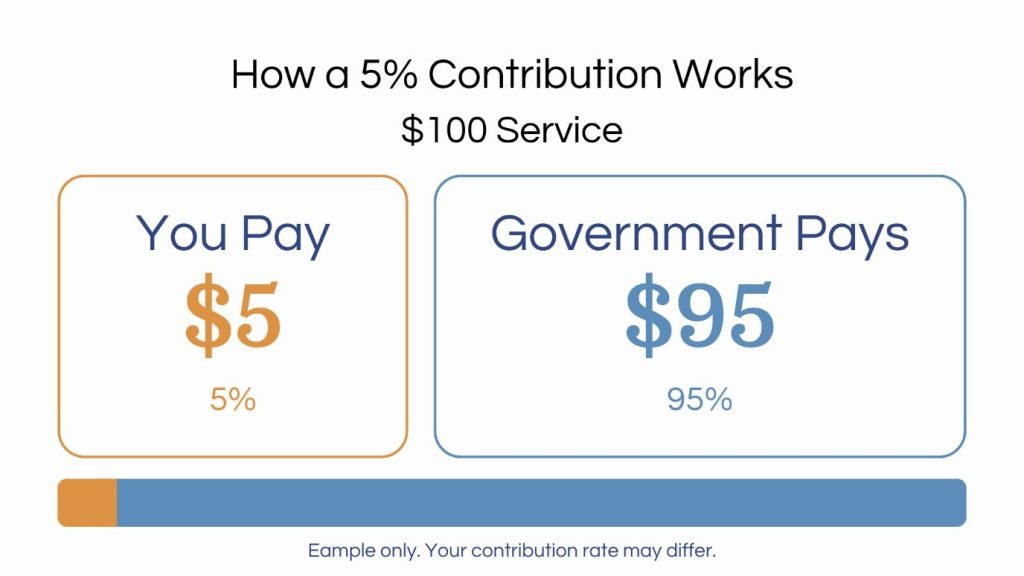
How a 5% contribution works on a $100 service: you pay $5 and the government pays $95

Is my contribution calculated on my whole budget?

No, your contribution is calculated on the services you receive and the contribution rate for each service. You are not charged a percentage of your entire allocation simply because the funding is available.

The full-service price, including your contribution, counts towards your budget. Your personal payment does not automatically add extra spending capacity.

Will I pay the same amount with every provider?

Not necessarily, because providers can charge different prices.

Your contribution percentage may remain the same, but the dollar amount changes with the service price. A 5% contribution is $5 on a $100 service and $6 on a $120 service.

Compare the total price, appointment length and included services. Higher prices affect both your personal contribution and how much support your budget can purchase.

What will I pay for equipment and home modifications?

Eligible equipment and home modifications generally attract your Independence contribution rate. Examples include approved mobility aids, shower chairs, communication equipment, grab rails and ramps.

These purchases use the Assistive Technology and Home Modifications pathway or eligible retained Home Care Package funds, rather than your ongoing quarterly services budget.

Approved clinical prescription and associated clinical support have a 0% contribution rate. Before agreeing to a purchase, ask for an itemised quote showing the equipment, professional services, funding source and your personal contribution.

Read our Assistive Technology and Home Modifications guide for the approval process.

What is the Wallet?

The Wallet is a small reserve of your own money we hold to pay your care providers on time.

Think of it like a float. Instead of billing you each time an invoice arrives, we keep a buffer ready so payments go out smoothly without delays. The money is held safely in trust, it is always yours.

The buffer is usually around two weeks’ worth of your expected contributions. You don’t manage it. We handle everything.

How does it get topped up?
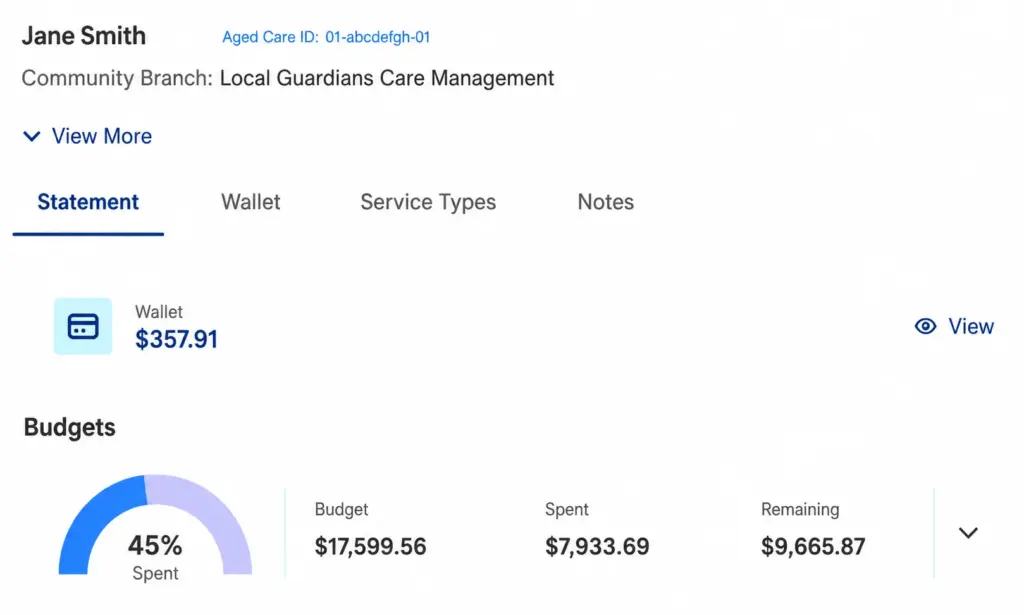
How the Wallet balance is topped up by direct debit

When the balance drops below the minimum, it is topped up automatically by direct debit. You’ll get a notification each time.

We can’t notify you a few days in advance, top-ups are triggered by invoices as they arrive, and those can’t be predicted ahead of time.

  • Default minimum balance: Two weeks of your budgeted personal contribution.
  • Optional: rounded buffer (recommended)

Based on experience managing packages for thousands of clients, we suggest rounding up to:

  • Minimum balance: $100 (or the nearest $100 above your two-week default)
  • Top-up amount: $200 (or the nearest $200 above your default)

This is not a requirement. The exact minimum can be requested to be different, just be aware it may result in more frequent top-ups, sometimes on consecutive days, and will delay service provider payments.

Why bother?

Invoices don’t arrive evenly, some weeks are quiet, others have several at once. A slightly higher, rounded buffer means fewer top-ups (average 13 per year, considering the direct debit is a four week budgeted value), no back-to-back direct debits, ensuring fast service provider payments and a simple amount that’s easy to remember.

How can I find out what my care will cost?

Ask your Care Advisor to prepare an estimate using your confirmed contribution rates, the services you need and current prices.

The estimate should explain how often each service will be provided, what you will pay and how the full cost will affect your budget.

Your monthly statement records the services delivered, charges, contributions and remaining funding. You can also use the My Aged Care Support at Home fee estimator for an initial estimate.

Support at Home Budget Planner

Back to index

How is GST handled on my Support at Home spending?

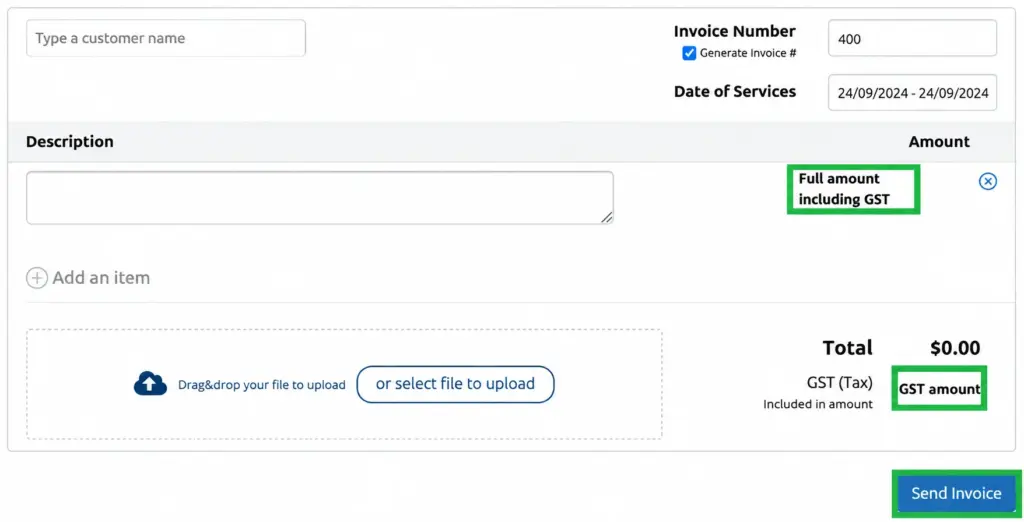
GST on goods and services provided under Support at Home cannot be paid directly from the Support at Home funding. Instead, GST should be clearly identified when invoices are uploaded, allowing Local Guardians to manage the GST payment separately.

This ensures that the GST portion is not drawn from the Support at Home funding, preserving those funds for the recipient to allocate towards additional care and services.

The full invoice amount, including GST, is paid to the service provider or reimbursement account in one deposit.

How GST is identified and paid separately on an invoice
Back to index

Can I apply for financial hardship assistance?

Tell your Care Advisor if paying for services is becoming difficult.

You may be eligible for financial hardship assistance through Services Australia. If approved, assistance can cover some or all of your required contributions.

A lifetime cap also applies to eligible contributions. The applicable amount depends on your contribution arrangements and changes with indexation. Services Australia can confirm your cap and how it applies to you.

Back to index

How does Local Guardians charge for care management?

No, care management has a 0% personal contribution rate.

For ongoing Support at Home services, 10% of your quarterly funding is allocated to care management. This supports activities such as planning your care, coordinating services and reviewing your needs.

The allocation comes from your funding. It is not an additional personal care management fee.

All registered Support at Home providers have the same fee structure

  • Care Management is capped at 10% of the funding set by the government.
  • All other administration costs are included in the unit prices of services.
  • This means the only pricing difference between providers is the unit cost of each service, like nursing or personal support, where most funding is spent.
  • Local Guardians is different because we’re an independent provider. We don’t employ carers or set fixed service prices. Instead, our clients self-manage and choose their own carers at the best market rate, with a flat 10% administration fee added to the service cost.

Care Management Fee: 10%

Under Support at Home, the government keeps 10% of each participant’s care funding for Care Management. This amount pays the provider’s Care Managers for the time they bill when planning, checking, and adjusting care to meet each person’s needs and follow government rules. If not all of the 10% is billed and it isn’t used to support other participants’ care management, the government keeps what’s left.

The 10% also works a bit like insurance. Care management is a mandatory government defined service, and everyone must receive it. Some people will need more support than others, and when that happens, the provider must still deliver the care management required, even if the time spent goes beyond what can be paid for.

Self Management Administration Fee

Because we don’t employ care staff or earn a margin from care services we add a 10% Administration Fee to each service provider invoice. This covers the costs associated with being a Registered Provider: things like quality, compliance, governance, payment processing and support. None of this can be covered by Care Management billing and is what keeps Local Guardians running behind the scenes.

Important: You only pay this fee when you receive services. If you’re not using your funding in a particular period, there are no fees charged.

How choosing your own providers saves money

As an example, a traditional ‘full service’ provider (who has their own care workforce) might charge $90/hour for a support worker. With us, you can engage a support worker of your choice for $50/hour + our admin fee ($5), totaling $55/hour. That’s $35 less per hour, resulting in significantly more care hours from the same budget.

Back to index
Still have a question?

Talk to your local Care Advisor. Call the number for your state or email customer@localguardians.com