


Learn what sets Local Guardians apart and how we support you every step of the way.

What’s included or excluded from Support at Home funding has more grey areas than black or white.
The care and services provided need to meet the care needs set out in their My Aged Care Support Plan and Care Plan. These are based on the needs identified during the ACAT or RAS assessment when first entering the SaH program. Simply having items listed in the care plan and budget does not automatically make them allowable.
Ready to explore what Support at Home funding can be used for? Click on each category below for more detailed information.
Transport and personal assistance with shopping, visit health practitioners, emotional support, social support and attending social activities.
Cabcharge (not rideshare services such as Uber) can be used for accessing local aged care transport needs: medical appointments, age related social activities, religious activities, shopping.
Private Transport costs for KMs, may be allowable in extenuating circumstances, such as living in a remote area (MMMs 4-7), with no other transport options available. To be discussed with your Care Advisor and a budget set.
Specialised and complex equipment that is generally adjusted to suit the care recipient’s individual support needs requires a recommendation from an appropriate health professional. It is important to make sure the equipment is supplied and set up correctly to avoid any risk of injury. Self-diagnosed or non-evidence-based items are not allowable. The cost of the assessment can be included in the package.
Not everything recommended by the Occupational Therapist (OT) is an allowable HCP expenditure item. An OT can identify strengths and difficulties and will help the client work out practical solutions to develop, recover, improve, as well as maintain the skills needed for daily living and working.This may include modifying an activity or an environment, recommendation, customisation and oversight of equipment provision. They use a range of specific therapeutic procedures to enhance performance such as wound care management, techniques to enhance sensory, perceptual, and cognitive processing, and manual therapy technique skills.
We refer to the Enable NSW Professional Criteria for Prescribers for guidance on who can prescribe different types of equipment. A GP is not qualified to recommend equipment.
Inclusions:
Click here to find out more about equipment approval timeframes.
When making decisions about Support at Home funding inclusions and exclusions and how funds can be spent we take time to consider the Decision Making Process, which covers considerations such as:
Although there is some uncertainty, the Department of Health and Aging is very clear on stating that Support at Home funding:
In addition, all Support at Home spending:
Absolutely! We’ve created two separate webpages covering Home Care Package inclusions and exclusions. Click the links below to visit these pages.
https://localguardians.com/home-care-package-exclusions/
** Note this information is currently in the proces of being updated to reflect the new Support at Home Program
** Note the below information is currently being updated in line with the new Support at Home Program
In order for aids or equipment to be approved
In most cases any aids or equipment will need a recommendation from the appropriately qualified allied health professional, this is generally an Occupational Therapist, but might be a Physio or Registered Nurse depending on the equipment.
Aids and equipment purchases MUST be:
Aids and equipment purchases must NOT be:
Click here to find out more about equipment approval timeframes.
All items need to be in the care plan and budget prior to committing any funds, this is the opportunity to discuss the expenditure with your Care Advisor. If there is additional information needed or specialist recommendations required, this will be communicated to you. Providing a detailed description will assist in assessing if the expenditure is allowable. You will be notified by your Care Advisor if the expenditure has been approved.
If we determine that the expenditure is not in scope for the package, we will discuss the reason why with you. We can also provide a written explanation of why the item was rejected.
If you are not satisfied with this outcome you may wish to seek assistance for dispute resolution from an independent advocacy service. The Aged Care Advocacy Service accepts enquiries at www.opan.com.au or 1800 700 600.
Should you wish to appeal the decision or make a complaint, contact the Aged Care Quality and Safety Commission: https://www.agedcarequality.gov.au/ . The Commission’s telephone number is 1800 951 822.
Allowable expenditure is one of the biggest minefields for approved providers. There is always new information and clarifications on inclusions/exclusions being released. Different providers adhere to the expectations to varying degrees, meaning that there are discrepancies between what clients have approved with different providers. Even with the same provider an item that was approved in the past, may no longer be approved.
Despite there being many items that can’t be included in the package, there are still plenty of opportunities for clients to fully utilise their funding. If you need assistance with ideas, you can consult the Allowable Expenditure – Inclusions Page and/or contact your Care Advisor who can work through your needs to see what else can be included.

If you’re receiving Support at Home Funding (from 1 November 2025), you receive a government budget to help you live safely and well at home.
Most people will also pay a personal contribution, a percentage of the cost of some services. This is not a penalty, it is how the program is designed so that people who can afford to contribute, do so fairly.
Your Support at Home budget works like “buckets of support”, into three broad buckets:
Each bucket works a little differently when it comes to your contribution.
| Type of Support | What is it? | What Will You Pay? |
|---|---|---|
| Clinical (health) | Services that protect your health, safety, and wellbeing. They are often delivered by qualified professionals.
Nursing care, physiotherapy, care management, consumables (medical supplies), dietitian/nutritionist, occupational therapy, podiatry, psychology, speech pathology, exercise physiology, counselling, social work, music therapy, Aboriginal and Torres Strait Islander health supports. |
0% |
| Independence | Services that help you stay independent, connected, and able to manage day-to-day life.
Personal care, social support, transport, help with showering, dressing, toileting, help taking medication, continence support, social, community and cultural support, digital support (learning to use phones, tablets, email), help managing personal affairs (paperwork, bills, appointments), therapies that support wellbeing (not strictly medical), acupuncture, chiropractic, massage, art therapy, osteopathy, diversional therapy, respite, special cushions or continence products, home modifications, equipment and aids (walking frames, shower chairs, grab rails), assistive technology. |
Between 5-50% |
| Everyday | Services often recognised as “home help”. Most people do pay a contribution toward everyday services because these are things many people would normally pay for privately if they didn’t have Support at Home.
House cleaning, laundry, shopping help, home maintenance minor repairs, gardening, meals. |
Between 17.5%-80% |
What does “percentage contribution” really mean?
Your personal contribution is the portion of the service cost that you pay yourself.
For a service costing $100:
| Your Contribution Rate | You Pay | Your Funding Pays |
|---|---|---|
| 0% | $0 | $100 |
| 5% | $5 | $95 |
| 17.5% | $17.50 | $82.50 |
Support at Home is designed to balance government funding with fair personal contributions, so people who can afford to contribute do so, while essential health care remains protected. How much you pay depends on the type of support you use and your income and assets, not a one-size-fits-all fee. Understanding these differences can help you plan with confidence and make informed choices about your care. Our interactive Support at Home budget planner is a simple guide to help you see how your funding and contributions may work in practice.
Support at Home Budget Planner
https://localguardians.com/understanding-support-at-home-and-personal-contributions/
Under Support at Home, the amount you contribute depends on:
Clinical services are fully funded by the Australian Government, regardless of your pension status. Contributions apply mainly to independence and everyday living services.
| Your Financial Status | Clinical Services | Independence Services | Everyday Living Services |
|---|---|---|---|
| Full Pensioner | 0% | 5% | 17.5% |
| Part pensioner or self-funded Commonwealth Seniors Health Card holder | 0% | Between 5% and 50% | Between 17.5% and 80% |
| Self-funded retiree without a Commonwealth Seniors Health Card | 0% | 50% | 80% |
| Income and assets not disclosed | 0% | 50% | 80% |
For part-pensioners and Commonwealth Seniors Health Card holders, the exact percentage is calculated on a sliding scale based on the income and assets assessment completed by Services Australia or, where applicable, the Department of Veterans’ Affairs.
Your contribution is paid in addition to the government subsidy. It does not come out of your government-funded portion of the service cost.
Full pensioners pay the lowest standard contribution rates:
Part pensioners and self-funded Commonwealth Seniors Health Card holders pay rates based on their assessed income and assets:
The exact rate is not determined by pension status alone. Services Australia applies a tapered rate based on the outcome of your individual assessment.
Self-funded retirees who are not eligible for a Commonwealth Seniors Health Card generally pay the maximum standard rates:
A person who does not receive a pension may still qualify for a lower contribution rate if their assessed income and assets are comparable to those of a pensioner. They must provide their financial details to Services Australia for this to be considered.
Completing an income and assets assessment is not compulsory. However, if Services Australia does not have your current financial information and you choose not to provide it, you will be classified as *means not disclosed* and charged the maximum contribution rates. Clinical services remain fully funded:
Clinical services remain fully funded.
Full and part pensioners will generally have their rates calculated using information already provided for their pension assessment.
Commonwealth Seniors Health Card holders and self-funded retirees may need to complete the Support at Home Calculation of Your Cost of Care form, SA456, if Services Australia does not already hold current financial information.
For couples, half of the couple’s combined income and assets is included in each person’s assessment. The principal family home is exempt from the Support at Home assets test.
Once the assessment is completed, Services Australia will send a fee advice letter confirming the contribution rate for each service category.
You can use the Local Guardians Support at Home Budget Planner for a general estimate. Your official contribution rate will be determined by Services Australia following your income and assets assessment.
The My Aged Care Support at Home fee estimator can also provide an estimate using your pension status, income, assets and expected service costs.
Click the links below to view more information
Will I Need to Make a Personal Contribution?
What are the AT-HM funding tiers?
What Does the $15,000 Amount Mean?
What Documentation is Required?
How do I Access AT-HM Funding?
Do I Need an Occupational Therapist Recommendation before Purchasing Equipment?
Can I Purchase Second-Hand Equipment?
What if I do not have AT-HM Funding Approved?
What Code Should Be Included on the Invoice?
How Long Does Equipment Approval Take?
Before Purchasing or Hiring Equipment
AT-HM is a short-term pathway under the Support at Home program that provides separate funding for assistive technology and home modifications. This means approved participants do not need to save funding from their quarterly Support at Home budgets.
AT-HM funding may cover:
Items and services funded through AT-HM may attract a participant contribution, depending on the category.
Assistive technology products, equipment, home modifications and associated services attract a contribution equivalent to the independence service category.
Prescription and wraparound services fall under clinical supports and do not attract a participant contribution. These services are fully funded by the government for all Support at Home participants.
Assistive technology and home modification funding are allocated separately based on your assessed needs.
| Support Type | Tier | Funding Cap | Access Period |
|---|---|---|---|
| Assistive Technology (AT) | Low | Up to $500 | 12 months |
| Assistive Technology (AT) | Medium | Up to $2,000 | 12 months |
| Assistive Technology (AT) | High | Up to $15,000+ | 12 months (usually) |
| Home Modifications (HM) | Low | Up to $500 | 12 months |
| Home Modifications (HM) | Medium | Up to $2,000 | 12 months |
| Home Modifications (HM) | High | Up to $15,000 cap | 12 months (may be extended to 24 months) |
Notes:
AT and home modification funding amounts do not accrue. They are allocated for a fixed period, which is generally 12 months.
Funding must be spent, rather than only committed, during the allocation period. Providers then have an additional 60 days to finalise claims. After this period, the funds are no longer accessible.
Providers may charge for specific AT-HM administration and coordination activities that are not covered by care management. All charges must be agreed with you and included in your individualised budget.
| Charge Type | What it Covers | Cap (Maximum) |
|---|---|---|
| AT administration fee | AT-specific administration activities not covered by care management, including:
|
10% of the cost of the item or bundle, or $500 (whichever is lower). |
| HM coordination fee | Coordination and project management activities for home modifications, including:
|
15% of the total quoted home modification cost, or $1,500 (whichever is lower). |
For high-tier assistive technology, $15,000 is a nominal amount. Additional funding may be available through the AT high-tier over $15,000 process where evidence shows that it is required.
High-tier home modification funding is capped at $15,000 over a participant’s lifetime. Any unspent amount may be accessed through a later high-tier home modification allocation following an assessment.
Local Guardians will prepare an itemised individualised budget with you. This must include:
The amount charged to your funding cannot exceed the invoiced cost of the item or modification, together with the documented costs of prescription, wraparound services and provider administration or coordination.
All costs must be agreed and documented. If a price changes, Local Guardians must obtain your consent and record the agreement in writing.
AT-HM approval requires an aged care assessment and an approved funding-tier classification for assistive technology, home modifications or both.
Local Guardians will document your needs, goals and preferences in your care plan and prepare your individualised budget.
For home modifications, written consent from the homeowner may be required. Quotes must also provide enough information about the proposed work and associated costs.
In most cases, aids or equipment will need a recommendation from an appropriately qualified allied health professional.
This will generally be an Occupational Therapist, but it may be a physiotherapist, registered nurse or another appropriate health professional depending on the equipment.
Aids and equipment must:
Equipment must not:
A recommendation from an Occupational Therapist or other health professional does not automatically mean an item will be approved. Local Guardians must also confirm that the item complies with Support at Home funding requirements.
Second-hand equipment can be purchased using Support at Home funding, but additional considerations apply to ensure the equipment is safe, suitable and properly documented.
The following requirements apply:
Second-hand equipment should not be purchased until the item and supporting information have been reviewed and approved.
Yes. However, hired assistive technology equipment must be claimed through your AT-HM funding. It cannot be paid from your ongoing quarterly Support at Home budget.
If you need to hire equipment and do not have enough AT-HM funding, a Funding Application Form and documents showing evidence of your need can be completed and submitted to My Aged Care.
If your approved AT-HM tier is insufficient, Local Guardians can request a Support Plan Review and provide evidence to support an increase in your funding tier.
The invoice must use the Services Australia claiming code that matches the type of equipment. There is no separate claiming code for hired equipment.
| Equipment being hired | Services Australia claiming code |
|---|---|
| Mobility equipment, such as a wheelchair, walker, shower chair, bed pole or transfer aid | SERV-0063 Mobility products |
| Continence, toileting, showering, dressing or personal care equipment | SERV-0062 Self-care products |
| Domestic or adaptive household equipment | SERV-0064 Domestic life products |
| Communication, alerting, tracking or information-management equipment | SERV-0065 Communication and information management products |
| Pressure care, positioning, respiratory or body-support equipment | SERV-0061 Managing body functions |
| Clinical prescription, assessment or setup support | SERV-0066 Assistive technology prescription and clinical support |
Approval times begin after all supporting documentation has been submitted, including the care plan and budget.
Most equipment requests are reviewed within one to two business days once the required documents have been received.
Requests involving mobility scooters, electric wheelchairs, mechanical lifting equipment or mechanical vehicle lifters generally require five business days.
The documentation required depends on the equipment. It may include:
Incomplete requests may take longer because the approval timeframe does not begin until all required supporting information has been provided.
All items must be included in your care plan and budget before you commit any funding.
Speak with your Local Guardians Care Advisor before purchasing, ordering or hiring equipment. If additional information or a specialist recommendation is required, your Care Advisor will let you know.
You will be advised when the request has been approved.
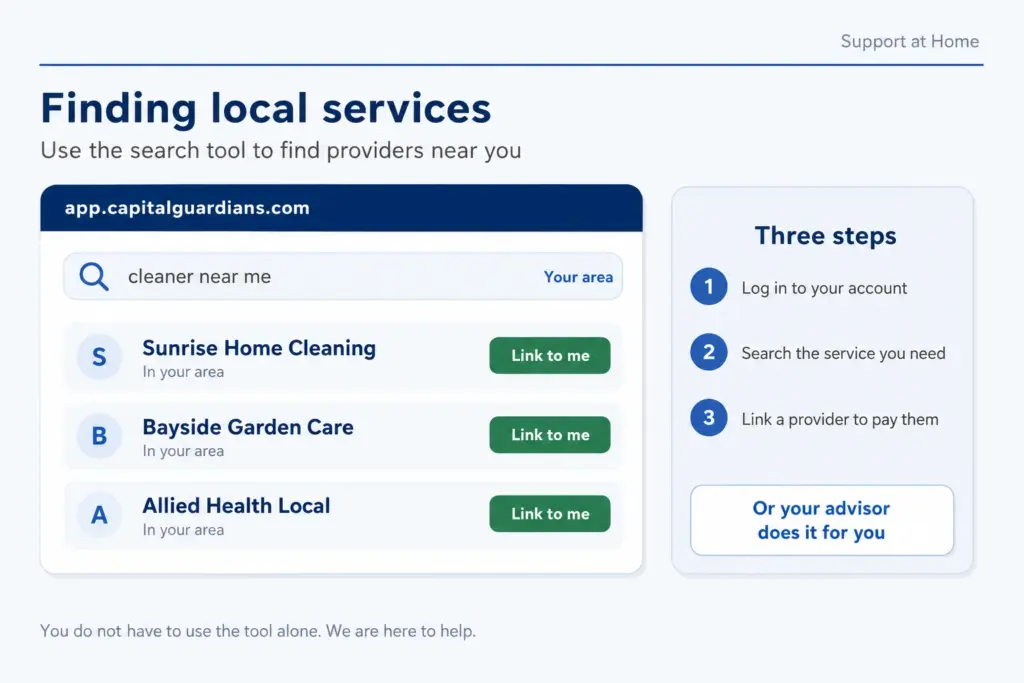
Local Guardians runs on the Capital Guardians platform, which includes a search tool to help you find local providers such as cleaners, gardeners, support workers and allied health.
To use it:
Alternatively, you can follow this link
If you would rather not do this yourself, your care advisor can find and set up providers for you. You do not have to use the tool alone.
Your Capital Guardians account allows you or your authorised representative to view your account, invoices and payments online at any time.
Your account is updated in real time, similar to a bank statement. When a new invoice is uploaded, your available funds will be updated to reflect the change.
Once your funding has been allocated, a monthly statement will also be emailed to the primary representative listed on your Local Guardians agreement.
Your account can be viewed online at any time and is updated as invoices and payments are processed.
Your monthly statement will be sent by email once the funding for the relevant period has been allocated. You do not need to wait for the statement to view activity in your Capital Guardians account.
To view the complete statement information, generate a printable or PDF statement from your Capital Guardians account.
When selecting the statement period, enter the first and last date of the most recently completed month.
Your monthly statement includes key figures relating to your funding balance, government funding, contributions and spending. The figures may be displayed as monthly totals and daily amounts.
Your opening balance is the amount of funding available on the first day of the month.
This shows the government funding credited to your account during the month.
The amount is calculated using the applicable daily subsidy rate and the number of days in the month.
This shows any additional government supplements credited to your account.
The amount is calculated using the applicable supplement rate and the number of eligible days in the month.
This applies where you have been assessed as needing to contribute towards the cost of your care.
The amount may appear as a deduction from the government funding credited to your account.
This shows the amount collected from you by direct debit during the month.
The direct debit amount may differ from the assessed contribution shown elsewhere on the statement because direct debits are generally processed fortnightly.
This is the total value of invoices processed during the month.
Your closing balance is the amount of funding available on the final day of the month.
Invoices move through several stages as they are submitted, claimed, reviewed and paid.
| Invoice Status | What it Means |
|---|---|
| Unclaimed | The invoice claim has not yet been submitted to PRODA. |
| Processing | The claim has been submitted to PRODA and is being processed. Government payment is still pending. |
| Funded | Full government payment has been received. The invoice is ready for payment, subject to approval and sufficient available funds. |
| Underfunded | The government payment received is not enough to cover the claimed invoice, so the invoice cannot yet be paid. |
| Pending Review | An issue with the invoice or account information is preventing the invoice from being claimed or paid. Further review is required. |
| Paid | The invoice has been paid successfully into the provider’s nominated bank account. |
An invoice may remain unpaid while:
The invoice status shown in Capital Guardians will indicate its current stage.
You or your authorised representative can log in to Capital Guardians at any time to view your account activity, invoices and payments.
The monthly statement is emailed to the primary representative recorded on your Local Guardians agreement.
The Aged Care Act 2024 puts the rights of older people first. It includes a Statement of Rights for older people accessing aged care services. This page is a plain-language summary of those rights.
The Statement of Rights explains what rights older people have when accessing aged care services funded by the Australian Government. It replaced the Charter of Aged Care Rights on 1 November 2025.
The Statement of Rights helps make sure you are at the centre of your aged care.
It gives you the right to:
You have the right to make your own decisions and have control over:
You have the right to get support to make these decisions if you need to.
You also have the right to choose how you live, even if there is some personal risk. For example, choices about your social life and close relationships.
You have the right to a fair and accurate assessment to find out what funded aged care services you need.
This assessment should be done in a way that suits you. It should respect your:
You also have the right to get the kind of care you need, when you need it. This includes palliative care and end-of-life care.
You have the right to safe, quality and fair funded aged care services that treat you with dignity and respect.
This includes the right to access funded aged care services that:
You have the right to access funded aged care services from:
If you feel unsafe when accessing aged care, you can get free support from lawyers, social workers and other specialists.
Your provider must:
You have the right to get records and information about your rights and the funded aged care services you use. This includes how much they cost.
You have the right to:
You have the right to communicate in the language or method you prefer. This includes using interpreters or communication aids if you need them.
You also have the right to meet with your provider and your supporters in a way that suits you. That might mean meeting at a time of day that works best for you.
When there are issues with your funded aged care services, you have the right to:
You may need support to understand your rights, make decisions or make a complaint. You have the right to get this support from an independent advocate or someone else you choose.
You have the right to communicate with your advocate or support person at any time you like.
Providers should respect the role of the people who are important to you. For example, family, friends and carers.
Aboriginal and Torres Strait Islander peoples have a right to stay connected with their community, Country and Island Home.
How can I make sure my rights are upheld?
Your provider must understand and follow the Statement of Rights. If they do not, you can make a complaint to the Aged Care Complaints Commissioner.
You can make a complaint online, by phone or by letter. Visit the Aged Care Quality and Safety Commission website for more information.
If you need support to make a complaint or find information, call the Older Persons Advocacy Network, known as OPAN, on 1800 700 600.
OPAN has free, independent and confidential advocates to help you.
Please visit the link below for the full Aged Care Act 2024 Statement of Rights
We would always like the chance to fix a problem first, so please raise it with us. If you are not happy with how we respond, you have every right to take it further. These services are free and independent.
You will not be treated differently for making a complaint. Speaking up helps us and the wider system improve.

A shift note is a short written summary of what was completed during a service. It also records important information about how the client is doing and whether there are any concerns about their wellbeing or condition.
Shift notes are more than a compliance requirement. They provide a safety net for both the client and the support worker and help everyone involved in the client’s care respond promptly to concerns.
They also provide a record of the services delivered if there is a complaint, incident or dispute.
During an emergency, shift notes can provide important information to support immediate and appropriate care.
If there is a disagreement about when a worker arrived or what was completed during a service, clear shift notes provide a record of what occurred on that day.
The Department of Health, Disability and Ageing oversees Support at Home funding and requires providers to maintain appropriate records of the services delivered.
Regular observations from service providers help Local Guardians understand the client’s circumstances and identify and respond to changes. This allows care and support to be adjusted when needed and helps the client remain safe and independent at home.
Any service delivered through the Support at Home program requires a shift note.
This includes:
For cleaning, gardening and allied health services, a brief description of the tasks completed and any relevant comments about the client’s welfare, where the provider saw the client, is sufficient. A shift note may only need to be a few sentences. Allied health providers are not required to enter a full report or health summary as the shift note.
A shift note should describe the support provided, or any support the client declined, and record the main activities and outcomes from the service.
It should include:
The information should confirm that the activities delivered match the services that were scheduled.
Shift notes should be entered promptly so the details are accurate and any concerns can be responded to quickly.
Providers may use voice-to-text features on their mobile devices to record information before transferring it into Capital Guardians.
Shift notes must not be uploaded in bulk on a weekly or monthly basis. Delayed notes can prevent Local Guardians from acting quickly when an adverse event or important change occurs.
No. Providers cannot charge an administration fee to the client’s Support at Home funding for entering shift notes.
Recording what occurred during a service is part of maintaining appropriate service records. Shift notes should be brief and focused and are not intended to be a full report.
Shift notes may be viewed by:
Shift notes must therefore be professional, objective, accurate and entered promptly.
Shift notes are a requirement for services funded through Support at Home.
A client cannot continue using Support at Home funding to pay a worker who does not provide the required shift notes.
Where a provider needs help understanding or submitting shift notes, they should contact Capital Guardians or Local Guardians as soon as possible.
If the provider is unwilling to meet the requirement, the client can use the Capital Guardians Provider Search or speak with their Care Advisor for assistance finding another provider.
VIC & TAS: (03) 7067 0555
NSW & ACT: (02) 7227 7661
QLD & NT: (07) 2139 7090
WA & SA: (08) 6383 8819